When Empire Met Athletics: How Rome Transformed Greek Sport Into the Ultimate Entertainment Machine
When Conquest Changed Everything
In 146 BC, Roman legions marched into Greece and changed the course of sports history forever. What they found wasn't just another territory to govern—it was a thousand-year-old athletic tradition that had captivated the Mediterranean world. The Olympics, with their sacred truces and amateur ideals, represented everything Rome wasn't: spiritual, pure, and gloriously unprofitable.
Rome had a different vision for what sport could become.
The Romans didn't destroy Greek athletics—they did something far more complex. They absorbed it, repackaged it, and turned it into the world's first mass entertainment industry. Think of it as the ancient equivalent of what happened when television discovered football, or when streaming platforms started throwing billions at sports rights. Rome saw Greek athletic excellence and asked one simple question: how do we make this profitable?
The Sacred Becomes Spectacle
Greek Olympics happened every four years in Olympia, drawing maybe 40,000 spectators to witness competitions that honored the gods. Roman games happened whenever an emperor, politician, or wealthy citizen wanted to curry favor with the masses. The Colosseum alone could hold 80,000 people, and it was just one of hundreds of venues across the empire.
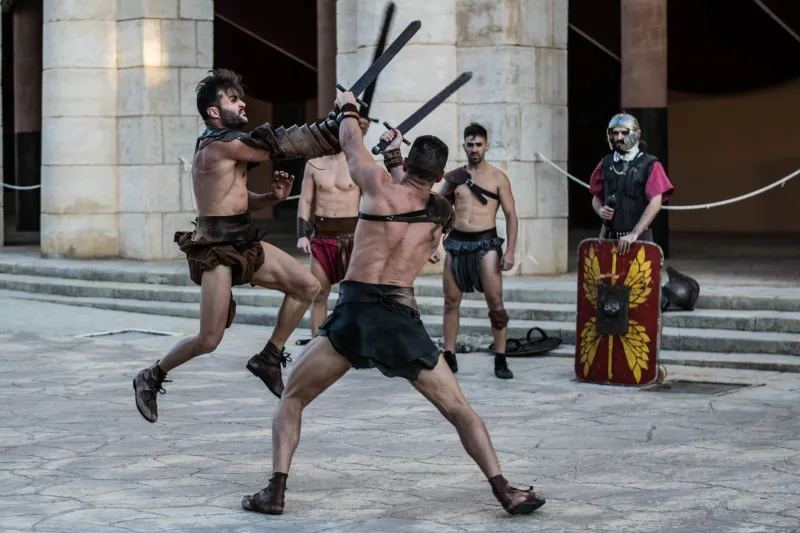
Where Greek athletes competed naked and received only olive wreaths, Roman performers became professionals earning serious money. The empire created the world's first sports agents, training facilities that resembled modern academies, and endorsement deals that would make today's NIL arrangements look modest. Star gladiators and chariot racers lived like celebrities, complete with fan clubs, merchandise, and retirement plans.
But Rome's genius wasn't just in scaling up Greek sport—it was in understanding what audiences really wanted. Greeks celebrated athletic perfection; Romans craved drama. The result was a fundamental shift that echoes through American sports today: from competition as spiritual practice to competition as entertainment product.
Building the Sports-Entertainment Complex
Roman innovations in sports entertainment were staggering. They created the first professional leagues, with chariot racing teams (the Blues, Greens, Reds, and Whites) that operated like modern franchises. Fans didn't just watch—they bet, they rioted, they lived and died with their teams' fortunes. Sound familiar?
The empire also pioneered what we'd recognize today as sports marketing. Gladiators endorsed products. Successful charioteers had their faces on pottery and mosaics. The most popular athletes became household names across three continents. Rome created the template for turning athletic achievement into cultural currency.
They even figured out scheduling and season structure. While Greeks held their sacred games on rigid four-year cycles, Romans created year-round entertainment calendars. Different cities hosted different specialties. Fans could follow circuits of competition that lasted months. It was the ancient equivalent of the modern sports calendar, where football season flows into basketball season flows into baseball season.
The Price of Professionalization
But Rome's transformation of Greek athletics came with costs that modern American sports are still grappling with. The empire's hunger for spectacle pushed competition toward extremes that would have horrified Olympic purists. Gladiatorial combat replaced wrestling. Chariot racing became less about horsemanship and more about crashes and casualties.
The Roman system also created the world's first debates about amateurism versus professionalism. Greek traditionalists watched in horror as their sacred competitions became commercial enterprises. Athletes who once competed for honor now performed for money. The very soul of sport seemed up for sale.
These tensions didn't disappear when the Roman Empire fell—they just went underground for fifteen centuries, waiting to resurface when the modern Olympics were revived. The same arguments that raged between Greek purists and Roman promoters still echo in today's debates about college athletics, NIL deals, and whether sport is about competition or entertainment.
The American Inheritance
When you watch the Super Bowl halftime show, you're witnessing Rome's vision of sport as spectacle. When college athletes sign endorsement deals, you're seeing the Roman model of professional athletics. When fans riot after championship wins, you're experiencing the same passion that once filled the Circus Maximus.
America inherited both sides of this ancient divide. We celebrate Olympic ideals of pure competition while building the world's most sophisticated sports entertainment industry. We want our athletes to be both amateur heroes and professional performers. We demand both sporting excellence and compelling storylines.
Rome showed us that once sport becomes entertainment, there's no going back. The empire proved that audiences will always choose drama over purity, spectacle over spirituality. But it also demonstrated that professionalization doesn't necessarily destroy athletic excellence—it just changes what excellence means.
The Legacy Lives On
The Roman transformation of Greek athletics wasn't just historical curiosity—it was the blueprint for every major sports league in America. The NFL's revenue sharing model? Roman innovation. The NBA's celebrity culture? Rome invented it. March Madness's ability to captivate an entire nation? The empire perfected that formula two thousand years ago.
Rome didn't steal Greece's greatest invention—it evolved it into something the modern world could actually use. The question isn't whether that evolution was good or bad, but whether we can learn from both traditions: the Greek pursuit of excellence and the Roman understanding of what audiences want.
Every time we debate whether sports have become too commercial, we're continuing an argument that started when Roman soldiers first marched into Olympia. The answer, as always, probably lies somewhere between the sacred grove and the Colosseum floor.