The Bull-Carrier of Croton: How One Ancient Wrestler Accidentally Invented Modern Strength Training
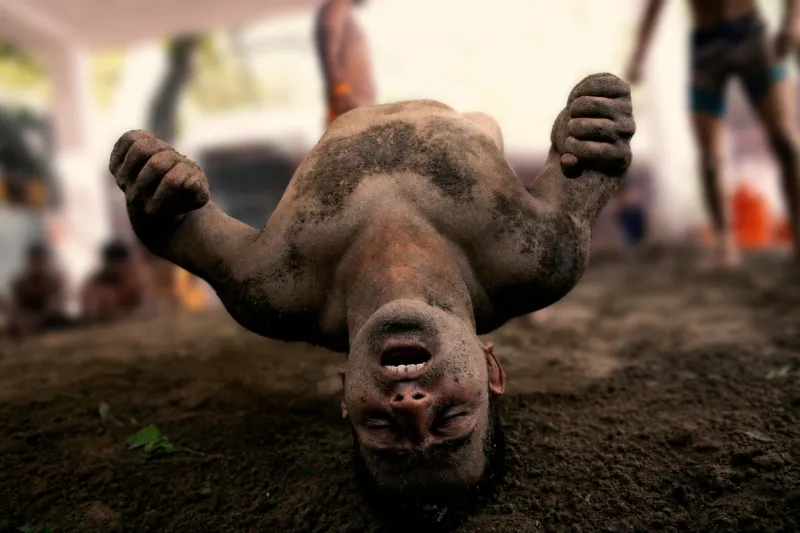
Picture a strength coach at an NFL training facility. He's got a whiteboard covered in load percentages, recovery windows, and progressive overload cycles. His athletes move through carefully staged phases — accumulation, intensification, realization — each one designed to push the body just far enough without breaking it.
Now picture a Greek wrestler in the sixth century BC, hoisting a newborn calf onto his shoulders and walking laps around the training ground at Olympia.
Same idea. Two and a half thousand years apart.
Milo of Croton is one of the most documented athletes in all of ancient history, which is saying something considering that documentation in 500 BC mostly meant someone writing your name on a stone. He won the wrestling event at six Olympic Games, along with seven Pythian Games, ten Isthmian Games, and nine Nemean Games. By any measure — ancient or modern — that career is absurd. And the method behind it, improbable as it sounds, holds up surprisingly well under modern scrutiny.
 Photo: Milo of Croton, via yummykitchentv.com
The Calf That Became a Bull
The story goes like this: Milo began his training regimen as a young man by carrying a newborn calf on his back. Every day, he did it again. The calf grew. Milo's body adapted. By the time the animal reached full size, Milo was carrying a bull — and his strength had developed in precise proportion to the increasing load.
Ancient sources, including Aristotle, treated this story as fact. Modern historians debate how literally to take it. But whether or not Milo literally walked around with a growing bovine, the principle embedded in the story is genuine and remarkably sophisticated.
What Milo was doing — or at least what the story describes — is progressive overload: the foundational concept behind virtually every serious strength training program in existence today. The idea is simple. You stress the body with a load it can barely manage. It recovers and adapts. You increase the load slightly. Repeat. Over months and years, that process produces strength that no single heavy lift could ever generate.
Every powerlifter, every offensive lineman, every Olympic weightlifter trains on this principle. It's the backbone of periodization theory, which modern sports scientists developed formally in the mid-twentieth century. Milo was running the same experiment in 540 BC.
What a Modern Sports Scientist Would Say
Dr. Tudor Bompa, the Romanian-Canadian exercise scientist widely credited with formalizing periodization theory in the 1960s, described training as a structured manipulation of volume, intensity, and recovery over time. His model — now standard in elite athletic programs worldwide — is taught in kinesiology programs at universities from Ohio State to Stanford.
Had Bompa been handed Milo's training biography, he would have recognized the architecture immediately. The daily repetition. The incremental load increase. The long timeline. The emphasis on functional, full-body movement rather than isolated muscle training. Milo wasn't lifting weights in a gym; he was moving a living, breathing, growing resistance tool through real space — which, from a neuromuscular standpoint, is arguably more demanding than a barbell.
Modern NFL strength coaches, particularly those working with interior linemen, often talk about "loaded carries" as one of the most effective tools for building functional strength. Farmer's carries, yoke walks, sandbag carries. The movement pattern Milo was performing — an asymmetric, shifting load carried across a distance — maps almost perfectly onto these drills.
If Milo walked into an NFL combine today, nobody would laugh at his training methodology. They might just ask him to stop bringing the livestock.
Six Olympic Titles and a Legend That Outlived Greece
Milo's competitive record is the part that's hardest to contextualize for a modern audience. Wrestling in the ancient Olympics wasn't a weight-class sport — there were no brackets, no divisions, no 265-pound limit. You competed against whoever showed up, and you won by throwing your opponent to the ground three times. Milo did this well enough to win the Olympic title six times across a career that stretched roughly from 540 BC to 516 BC.
That's a 24-year window of elite competition. For comparison, Dan Gable — arguably the greatest American wrestler in history — dominated for about a decade before transitioning to coaching. Milo's reign makes Gable's look brief.
Ancient accounts describe Milo as physically enormous, capable of holding a pomegranate in his fist without crushing it (demonstrating control) and standing on an oiled discus without being pushed off (demonstrating balance). He was said to eat twenty pounds of meat, twenty pounds of bread, and drink eighteen pints of wine per day — numbers that are almost certainly mythologized, but that speak to how ancient Greeks understood the relationship between mass consumption and physical power.
He was also, by multiple accounts, a student of Pythagoras. The mathematician and philosopher lived in Croton at the same time, and Milo reportedly served as a kind of protector of the philosophical school. The image of a wrestler who was also an intellectual companion of Pythagoras says something interesting about how ancient Greek culture valued the combination of physical and mental excellence — a concept the Greeks called arete, or virtue through complete human development.
 Photo: Pythagoras, via optorium.in
What Milo's Story Still Teaches Us
There's a tendency in modern sports culture to assume that everything useful was invented recently — that training is a product of sports science departments, that nutrition protocols emerged from research labs, that athletic development didn't really exist before the twentieth century. Milo's story complicates that assumption in the most direct way possible.
The man was doing progressive overload training before Rome existed as a republic. He was competing at elite levels into what we'd now call his late thirties or early forties. He built a career on consistency, incremental improvement, and an intuitive understanding of how the body responds to stress over time.
Modern athletes have better nutrition, better recovery tools, better coaching infrastructure, and better medical support. They would almost certainly outperform Milo in a controlled athletic setting. But the training principle he embodied — load, adapt, increase, repeat — remains as valid today as it was on the dirt training grounds of ancient Croton.
The bull-carrier of Croton didn't have a whiteboard. He didn't need one. He had a calf, a field, and twenty-four years of showing up.
That's the starting line every serious athlete still runs from.