Winning Was the Only Number That Mattered — Until It Wasn't
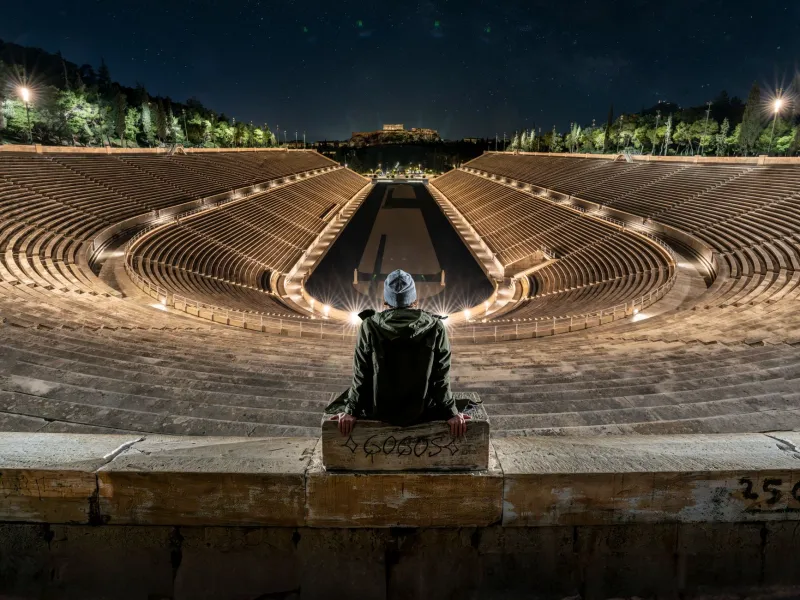
Imagine finishing a race and having absolutely no idea what your time was. No clock on the scoreboard. No announcer rattling off splits. No phone notification telling you that you just set a personal best. You crossed the line first, the crowd roared, and that was the whole story.
That was Olympic competition for more than a thousand years.
The ancient Greeks who gathered at Olympia every four years starting in 776 BC weren't building a database of athletic performance. They were staging a religious festival in honor of Zeus, and the only thing that mattered when a runner hit the finish was simple: did he get there before everyone else? First place was everything. Second place was, depending on the era and the event, closer to humiliation than achievement. There was no silver lining in ancient Greece — literally. Victors received an olive wreath. Everyone else went home with nothing but the memory of losing.
No Clock, No Problem
The ancient Olympics had no timing devices because they didn't need them. The stadion — the original foot race, roughly 200 meters run the length of the stadium at Olympia — was decided by human eyes. Judges called Hellanodikai watched the finish and declared a winner. That was the entirety of the officiating process.
There were no qualifying standards, no seeding based on previous performances, no heat times to compare. Athletes didn't train to beat a number. They trained to beat the man next to them. The finish line was the only measurement that existed, and it was a binary one: you either crossed it first or you didn't.
This wasn't a limitation of ancient Greek culture — it was a philosophical position. Victory was a gift from the gods. To ask how much you won by would have been almost beside the point. The win itself was the sacred thing.
The Long Road to the Stopwatch
The modern revival of the Olympics in Athens in 1896 didn't immediately flip this switch. Early timekeeping at the Games was rudimentary, often handled by officials with handheld stopwatches that could measure to the nearest fifth of a second on a good day. Times were recorded, but they weren't the centerpiece of competition. Athletes still ran to win races, not to chase numbers.
But something had changed. The industrial age brought with it an obsession with measurement, efficiency, and optimization. By the time the 20th century hit its stride, sports science was beginning to emerge as a real discipline. Coaches started keeping training logs. Times were compared across meets, across nations, across decades. Athletes weren't just racing each other anymore — they were racing the record book.
The shift accelerated dramatically through the mid-20th century. By the 1960s and 70s, Olympic sprinters weren't just training to beat the guy in lane four — they were training to shave hundredths of a second off times set years earlier by athletes they'd never met. The finish line had become secondary to the clock.
When the Clock Became the Competition
Here's where the ancient and modern worlds diverge most sharply. In a world without timing, training is about competitive dominance — reading opponents, running tactically, peaking for the right moment. In a world where hundredths of a second separate gold from silver, training becomes something else entirely: a scientific project.
Modern Olympic sprinters work with biomechanics specialists who analyze stride length and ground contact time. Swimmers train in facilities equipped with underwater cameras measuring their turn efficiency to the millisecond. Distance runners wear GPS-enabled devices that map their pace fluctuations across every single training run. All of it feeds back into one central question: how do we find the next fraction of a second?
Consider what this means in practice. At the 2020 Tokyo Olympics, the men's 100-meter final was decided by 0.04 seconds between gold and silver. Four hundredths of a second. In ancient Greece, both of those athletes would have been considered so close to simultaneous that the result might have been disputed. Today, it's not even particularly controversial — the photo finish is definitive, the gap is documented, and both athletes know exactly where they stand in the historical record.
What We Gained — and What We Lost
The quantification of athletic performance has produced genuinely extraordinary things. World records give sport a continuity that transcends generations. You can meaningfully compare Jesse Owens to Usain Bolt — not as a direct competition, but as data points in a long arc of human progress. The record book is, in its own way, a history of what human beings are capable of.
But something quieter got left behind in Olympia. When winning was the only thing that mattered, the competition itself was the whole story. The athlete who crossed first was the champion — full stop. There was no asterisk about conditions, no debate about wind readings, no discussion of whether the track surface helped or hurt.
Today, a world record set with a tailwind above the legal limit doesn't count. A performance achieved in an altitude-adjusted facility carries qualifications. The measurement has become so precise that we've had to build an entire regulatory framework just to decide which measurements are valid.
The Starting Line Is Still the Same
None of this makes modern sport lesser. If anything, the obsession with time has pushed human performance to places the ancient Greeks couldn't have imagined. The winning 1500-meter time at the 1896 Athens Olympics was 4 minutes and 33 seconds. Today's Olympic champions run it in under 3:30. That's not just faster — it's a fundamentally different relationship between a human body and distance.
But it's worth pausing to remember where all of this started: a dirt track in Olympia, a handful of athletes stripped of everything unnecessary, and a crowd waiting to see who got there first. No clock. No record. Just the race.
The finish line has always been the point. We just got a lot more precise about how we measure the path to it.