From the Gymnasium to the Quad: How Ancient Greece Accidentally Designed the American College Sports System
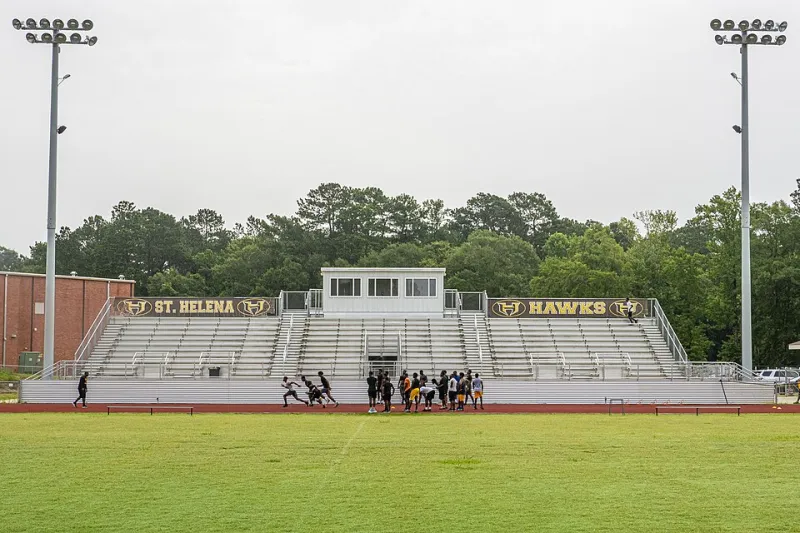
Photo: U.S. Department of Agriculture, Public domain, via Wikimedia Commons
Every fall Saturday in America, millions of people pack into stadiums to watch young athletes compete under institutional banners — Ohio State vs. Michigan, Alabama vs. Auburn, Texas vs. Oklahoma. The athletes are young, in the early stages of development, training under coaches employed by large civic institutions. Their victories belong not just to them but to their schools, their cities, and their regions. Their losses are felt communally.
This is, almost beat for beat, how athletic competition worked in ancient Greece 2,800 years ago.
The parallels between the ancient Greek gymnasium system and the modern American college athletics model are striking enough that it's worth asking whether we built something new — or accidentally rebuilt something very old.
What the Gymnasium Actually Was
The word "gymnasium" comes from the Greek gymnasion, derived from gymnos, meaning naked — a reference to the Greek practice of training unclothed. But strip away the etymology and the gymnasium was something much more recognizable: a publicly funded athletic training facility attached to civic life, where young men developed physically under professional instruction.
Gymnasia were found in virtually every significant Greek city-state. They weren't just places to exercise. They were institutions. Philosophers lectured in them. Coaches — called paidotribes — worked with athletes systematically, teaching technique, managing conditioning, and preparing competitors for major festivals like the Olympics, the Pythian Games, and the Isthmian Games.
The athletes who trained in these facilities competed not just for personal glory but for the honor of their city-state. A victory at Olympia didn't just make you famous — it made your polis famous. Cities celebrated Olympic champions with public feasts, financial rewards, and occasionally free meals for life. The athlete and the institution were bound together.
If that sounds like a university retiring a jersey number or a state governor congratulating a national championship team, it should.
The City-State Rivalry Problem
One of the most vivid features of ancient Greek athletics was the intensity of city-state competition. Athens and Sparta didn't just disagree politically — they competed fiercely for athletic supremacy. Corinth, Argos, and Rhodes each developed distinct athletic traditions and produced champions who carried those cities' reputations onto the competition floor.
The rivalry wasn't just about pride. It was about identity. Winning at the Panhellenic Games was a statement about the quality of your institutions, your training methods, your civic investment in athletic excellence. Cities that produced champions were cities that, by implication, had figured something out.
Run that same logic through the lens of modern college football and you'll find something nearly identical. The SEC's dominance over the past two decades isn't just about individual talent — it's about institutional investment, coaching infrastructure, recruiting pipelines, and the cultural weight placed on athletic success within specific regions. Alabama's dynasty under Nick Saban was, in the Greek sense, a polis asserting its supremacy through athletic achievement. The parallels are uncomfortably precise.
The Coach as Institutional Figure
In ancient Greece, the best coaches were celebrated figures. Melesias of Athens was famous enough that Pindar — the most important poet of athletic victory odes — name-dropped him in his work. Coaches built reputations that attracted the best athletes, which produced more victories, which enhanced the coach's reputation further. The feedback loop is familiar.
Modern college coaching works exactly this way. A coach builds a winning program, which attracts top recruits, which produces wins, which attracts better recruits. The coach becomes synonymous with the institution. Bear Bryant was Alabama. Bob Knight was Indiana. John Wooden was UCLA.
The ancient Greeks even had a version of the coaching tree — successful athletes who became coaches, passing methods down through generations of competitors. That lineage of knowledge transfer, from master to student to the next generation of masters, is essentially what the modern college coaching carousel looks like if you zoom out far enough.
Amateurism, Compensation, and the Ancient Argument We're Still Having
Here's where the parallel gets genuinely uncomfortable: the ancient Greeks had the same argument about athlete compensation that American college sports is having right now.
The official ideology of the Panhellenic Games was that athletes competed for honor — the olive wreath, the laurel, the glory. But in practice, successful athletes received substantial rewards from their home cities: cash payments, free housing, tax exemptions, guaranteed income. The "amateur" ideal was always somewhat fictional, a public-facing narrative that obscured a more transactional reality.
The NCAA spent most of the 20th century enforcing an amateurism model that looked remarkably like that ancient fiction — insisting that college athletes competed for the love of the game while the institutions around them generated billions of dollars. The recent NIL (Name, Image, and Likeness) revolution, which now allows college athletes to be compensated for their personal brand, is the American version of the Greek city-state quietly handing its Olympic champion a lifetime pension.
The argument being settled in courtrooms and athletic departments across the country today isn't new. The Greeks were having it in 500 BC.
What Gets Lost in the Translation
The ancient gymnasium system wasn't perfect. It was exclusionary by design — women were largely barred from competition, and the system was built on a social structure that kept enslaved people entirely outside athletic life. The American college sports system has its own deep inequities, particularly around race and economic access, that echo some of those ancient failures even as the surface has changed.
But the structural DNA is remarkably consistent. Young athletes, developed within civic institutions, competing for regional pride, under coaches who build dynasties, within a framework that publicly celebrates amateur ideals while privately operating on economic logic — that's the ancient Greek model. It's also Saturday afternoon in the Big Ten.
The Starting Line Was in Greece
From Olympia, the roots of organized athletics spread outward across centuries and continents. The gymnasium became the university athletic department. The paidotribes became the head coach with a multi-million-dollar contract. The city-state rivalry became the conference rivalry. The victory ode became the ESPN highlight reel.
America didn't invent college sports. It inherited an ancient system, dressed it in school colors, and called it something new. The starting line, as always, was somewhere in Greece.