Fourteen Men, Zero Budget, and a Boat They Almost Didn't Take
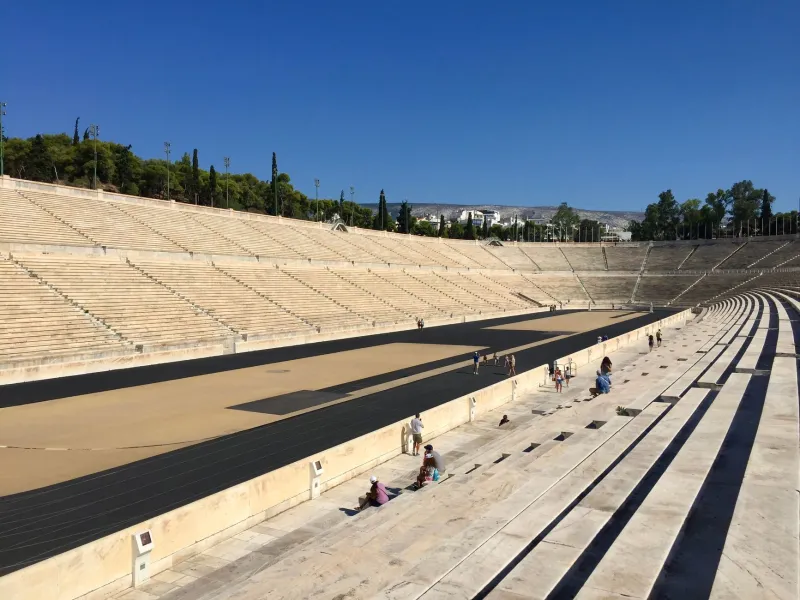
When Americans think about the U.S. Olympic program today, they picture a well-funded machine — professional athletes, corporate sponsorships, state-of-the-art training facilities, and a delegation that regularly tops the medal count. It's easy to assume it was always that way, that American athletic dominance was somehow built into the design from the beginning.
It wasn't. In the spring of 1896, the United States almost didn't show up at all.
A Skeptical Nation and a Very Long Boat Ride
When Pierre de Coubertin successfully lobbied for the revival of the Olympic Games and Athens was selected as the host city for 1896, the response from the American athletic establishment was something between indifference and outright skepticism. The idea of sending athletes overseas for a competition nobody had ever seen before — organized by a French baron, staged in a country most Americans couldn't point to on a map — didn't exactly set off alarm bells of excitement.
The U.S. had no official Olympic committee. There was no government funding. No corporation stepped up to write a check. The athletes who eventually made the trip were largely college men — students and recent graduates from Princeton and the Boston Athletic Association — who had to finance much of their own journey. Some of them paid out of pocket. Others relied on modest contributions from their universities or local supporters.
The logistics were a nightmare by any standard. The athletes boarded a ship called the Fulda in late March 1896, endured a two-week ocean crossing, and arrived in Naples with almost no time to spare before the Games began. The travel itself was grueling. Some of the men arrived in Athens physically depleted from the journey, having had almost no opportunity to train properly during the crossing.
And yet.
What Happened When They Got There
The 1896 Athens Olympics drew 241 athletes from 14 nations. The American delegation was small — estimates vary, but the core group numbered around a dozen competitors. They were amateurs in the truest sense: no professional coaching staff, no sports scientists, no advance team that had flown in to scout the venues.
What they had was raw talent and a competitive instinct that turned out to be more than enough.
The Americans won nine gold medals at those Games, dominating the track and field events in a way that shocked the other competing nations. James Connolly of Boston became the first Olympic champion of the modern era when he won the triple jump on the opening day of competition. Robert Garrett, a Princeton student who had never actually thrown a discus in competition before arriving in Greece, won the discus throw after teaching himself the technique in the weeks before the Games. Ellery Clark won both the high jump and the long jump. Thomas Burke won the 100 meters.
These weren't polished professionals executing a carefully laid plan. They were young men who had crossed an ocean on a shoestring, landed in an unfamiliar country, and competed anyway.
The Near-Miss That Almost Changed Everything
The story of how close the U.S. came to not going deserves more attention than it usually gets. In the months before the Games, there were serious discussions among American athletic administrators about whether the trip was worth attempting. The cost was prohibitive. The competition was unknown. The journey was long. Several prominent figures in American amateur athletics argued that the whole enterprise was premature and that the U.S. should wait to see whether the Olympics proved to be a lasting institution before committing resources to it.
The decision ultimately came down to a handful of individuals — coaches, administrators, and the athletes themselves — who pushed through the obstacles on conviction alone. William Sloane, a Princeton professor with connections to de Coubertin, was instrumental in organizing the American effort. Without his advocacy, it's genuinely possible that the United States sits out the inaugural modern Olympics entirely.
Think about what that alternate history looks like. No James Connolly. No Robert Garrett. No dominant American track and field performance to establish the template for what U.S. Olympic athletics would become. The founding mythology of American Olympic identity — the scrappy underdog who shows up underprepared and wins anyway — might never have been written.
Why This Story Still Resonates
There's something deeply American about the way the 1896 delegation came together. Not through institutional planning or government investment, but through a combination of individual determination, improvisation, and a refusal to be talked out of something worth doing.
The athletes who made that trip didn't know they were building the foundation of a century-long Olympic dynasty. They were just trying to compete. They scraped together the money, boarded the boat, and figured the rest out when they got there.
That spirit — show up, compete, and let the results speak — became a kind of unspoken code for American Olympic athletics in the years that followed. It's a code that traces a direct line back to a small group of college kids who almost didn't make the crossing.
The Delegation That Defined the Template
The modern U.S. Olympic Committee was formally established in 1900, partly in response to the lessons learned from the chaotic 1896 experience. Better organization, more funding, clearer selection processes — all of it grew from the recognition that the Athens experiment had worked despite itself, and that a more deliberate approach could make it work even better.
By the 1904 St. Louis Olympics, the U.S. had an organized program. By the 1920s, American athletes were consistently among the most dominant in the world. By the Cold War era, Olympic performance had become a matter of national prestige backed by serious institutional support.
All of it has a starting point. And that starting point is a boat called the Fulda, a group of young men who weren't sure the whole thing was a good idea, and a city in Greece that was about to see something it hadn't seen in fifteen centuries.
They almost didn't go. That they did changed everything.