Before the Stopwatch, There Was Only the God: How Ancient Athletes Competed Without a Ceiling
Ask any serious runner today what they're chasing, and they'll probably give you a number. A personal best. A qualifying time. A sub-four-minute mile. The modern athletic mind is wired for measurement—every race is a negotiation between the body and the clock, and the clock always wins the argument.
But travel back to Olympia, Greece, around 776 BC, and you'd find athletes competing under a completely different set of rules—not the written kind, but the mental kind. There were no stopwatches. No world records. No official times posted on a board. The only thing that mattered was who crossed the finish line first, and the gods were watching.
That distinction isn't just a historical footnote. It's the key to understanding why the psychological revolution in modern sport—the moment athletes started believing performance ceilings were breakable—may be one of the most significant turning points in competitive history.
Running Toward Zeus, Not the Clock
The ancient Olympics were, at their core, a religious event. Held every four years at the sanctuary of Zeus in Olympia, the games weren't designed to test the outer limits of human capability. They were designed to honor a god. Athletes competed for a wreath of wild olive leaves—an object with no monetary value whatsoever—and for the kind of glory that would follow them home to their city-state and echo through generations.
There was no bronze medal for second place. There was no honorable mention. In ancient Greece, finishing second was essentially the same as losing. The poet Pindar, who wrote elaborate victory odes for Olympic champions, barely acknowledged the runners-up. They "slunk back to their mothers," as one translation memorably puts it.
In that framework, the question was never how fast can a human run? The question was who is the fastest man here, today, in front of Zeus? Those are fundamentally different questions, and they produce fundamentally different athletes.
The Myth Was the Measurement
Without recorded times, ancient athletes filled the performance gap with something else: mythology. Stories of legendary competitors—men like Leonidas of Rhodes, who won twelve individual Olympic titles across four separate games—weren't analyzed through data. They were told like epic poems. Leonidas didn't run a 9.58 in the 100 meters. He ran like a man touched by the gods.
That framing had a strange double effect. On one hand, it meant there was no quantifiable ceiling to break. You couldn't look at a record and decide to beat it because no record existed. On the other hand, it also meant that mythic performance was the standard—and mythology, by definition, is a bar no mortal can reliably clear.
When your competition is a story rather than a number, you're not running against the clock. You're running against the legend. And legends don't crack.
When Numbers Changed Everything
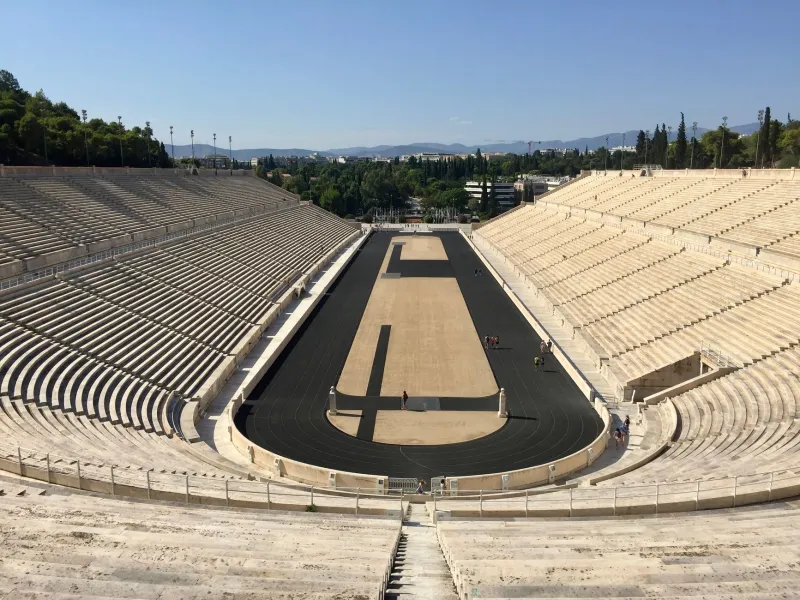
The shift came gradually, but the modern Olympics—revived in Athens in 1896—accelerated it dramatically. Suddenly, performance was documented. Times were recorded. Distances were measured. The 1,500-meter race at those first modern games was won in 4 minutes and 33 seconds. That number went into the books.
And once a number goes into the books, it becomes a target.
This is the psychological revolution that athletic historians often undersell. The act of recording a performance doesn't just preserve history—it manufactures ambition. Every documented time is an implicit challenge. Every world record is a ceiling that exists specifically to be broken.
Roger Bannister's 1954 sub-four-minute mile is the most famous example of this dynamic in action. The four-minute barrier wasn't a biological wall—sports scientists had been saying that for years. It was a psychological one. Once Bannister proved it was permeable, runners John Landy, Wes Santee, and others broke it within months. The barrier didn't move because of new training methods. It moved because the belief system changed.
Ancient athletes never had that problem—or that opportunity. Without a recorded ceiling, there was nothing to shatter. But there was also nothing to aim at.
Two Frameworks, One Finish Line
It's tempting to say one system was better than the other. It wasn't. They were optimized for entirely different purposes.
The ancient framework produced athletes of remarkable consistency and longevity—men who competed across multiple Olympiads because their motivation wasn't chasing a number but maintaining a relationship with glory and divine favor. The modern framework produces athletes who run faster, jump higher, and throw farther than any generation before them, because the documented record is always there, always visible, always one training cycle away from falling.
What both systems share is this: performance follows belief. Ancient Greek athletes believed they were competing in a sacred arena where excellence honored the gods. Modern athletes believe the record in front of them is breakable. In both cases, the belief system shaped what the body was willing to attempt.
Why It Still Matters
Sports psychology is one of the fastest-growing fields in athletics today, and its central premise would have made perfect sense to a fifth-century Greek trainer. The mind sets the ceiling before the body ever gets close to it.
What Olympia understood—even without stopwatches, photo finishes, or performance analytics—was that competition is as much a mental act as a physical one. The ancient Greeks just used mythology and religion to manage the mental side of the equation. We use data and record books.
Different tools. Same fundamental insight.
The next time you watch an Olympic sprinter shave a hundredth of a second off a world record, remember that somewhere in ancient Olympia, a runner was pushing himself toward a finish line with no time to beat—just a god to honor and a legend to become. Both athletes were chasing something just out of reach.
The finish line has always been the same. Only the ceiling has changed.