One Race to Rule Them All: The 2,800-Year Journey From Olympia's Dirt to the Olympic Sprinting Lane
One Race to Rule Them All: The 2,800-Year Journey From Olympia's Dirt to the Olympic Sprinting Lane
Picture this: it's 776 BC, the sun is hammering down on a valley in western Greece, and a crowd of thousands has gathered not for war, not for politics, but to watch men run. No shoes. No lanes. No electronic timing. Just bare feet, packed earth, and the kind of raw, desperate speed that separates the celebrated from the forgotten.
That single foot race — the stadion, a roughly 200-meter sprint run at the sanctuary of Zeus in Olympia — is the oldest recorded athletic competition in Western history. And here's the thing that should blow your mind a little: every time Noah Lyles explodes off the blocks at a Summer Olympics, he's running a direct descendant of that ancient Greek contest. The names have changed. The records have been shattered into pieces. But the fundamental challenge — who is the fastest human in the room — has never changed once in nearly three millennia.
What the Stadion Actually Was
The word stadion didn't just describe the race. It described the distance, and eventually it gave us the word "stadium" itself. The length was tied to the track at Olympia — approximately 192 meters, though the exact measurement varied slightly by location. Competitors ran the length of the track once, turned, and that was it. First one to the finish line won.
Simple. Brutal. Decisive.
The first recorded Olympic champion was a man named Koroibos, a cook from the city of Elis, who won the stadion in 776 BC. We don't know his time — nobody was keeping one — but we know his name survived 28 centuries, which is more than most athletes can say. For the first 13 Olympic Games, the stadion was the only event. It wasn't just the centerpiece of the ancient Olympics. It was the whole show.
Athletes competed in the nude, their bodies oiled and dusted with sand, starting from a standing position behind a stone or wooden threshold called a balbis. There were no staggered starts, no individual lanes, and no photo finishes. Judges — called Hellanodikai — watched from the side. False starts were punishable by flogging, which, safe to say, kept things pretty focused.
The Long Gap — and the Comeback
The ancient Olympics ran for over a thousand years before the Roman Emperor Theodosius I effectively shut them down in 393 AD, deeming the Games a pagan ritual incompatible with the newly Christianized empire. For the next fifteen centuries, organized international sprint competition essentially went dark.
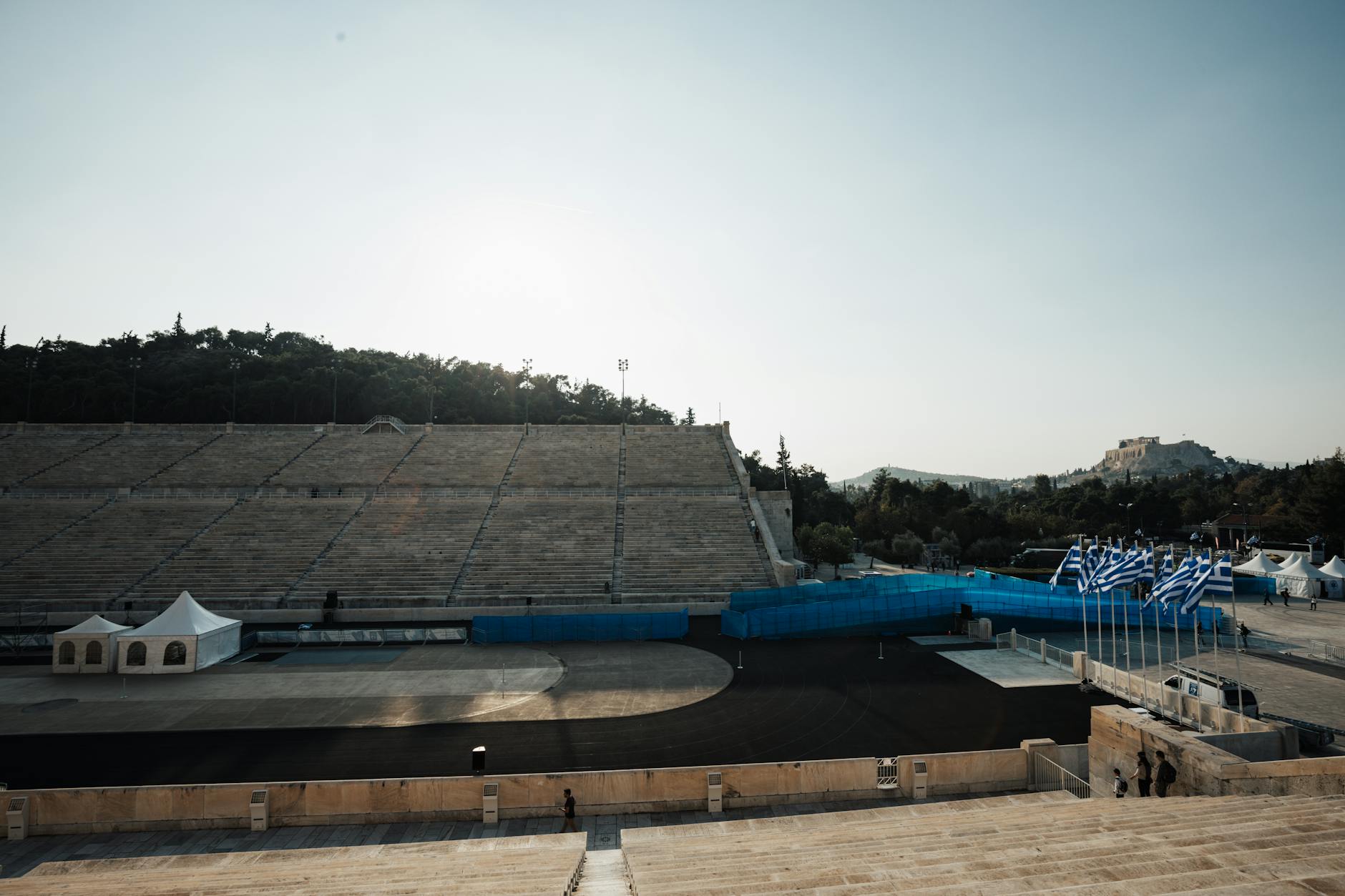
When Pierre de Coubertin revived the Olympic Games in Athens in 1896, the sprint was one of the first events back on the program — reborn as the 100-meter dash, a clean metric distance that fit the modern era's love of precision. American Thomas Burke won that inaugural modern sprint in a time of 12.0 seconds, running in a crouched start position he'd developed himself. The crowd at the Panathenaic Stadium had never seen anything like it.
Burke's technique was considered radical at the time. Within a generation, it was standard everywhere.
From Bare Feet to Biomechanics
The gap between Koroibos and today's elite sprinters isn't just a matter of better shoes — though the shoes are genuinely extraordinary now. It's the result of a complete reimagining of what the human body can do when you apply two centuries of sports science to a 2,800-year-old question.
Consider what modern sprinters have working for them that ancient Greek athletes simply didn't:
Starting blocks. Introduced at the 1948 London Olympics, starting blocks allow athletes to generate maximum force from a precisely calibrated position, driving off both legs simultaneously with explosive power. Ancient Greek competitors started upright, losing precious fractions of a second in those first critical strides.
Synthetic track surfaces. The rubberized, all-weather tracks used at modern Olympics were developed in the 1960s and have been refined ever since. They return energy to the athlete with each stride in a way that packed dirt or early cinder tracks simply cannot. Estimates suggest modern track surfaces alone may account for improvements of several tenths of a second over older surfaces.
Biomechanical coaching. Today's sprint coaches use high-speed video, force plates, and motion-capture technology to analyze every phase of a race — the drive phase, the transition, the top-speed phase, the maintenance phase. Ancient Greek athletes trained hard, but their coaching was built on observation and intuition, not data.
Nutrition science. The dietary protocols followed by elite sprinters — precise macronutrient timing, creatine supplementation, recovery nutrition — would have been completely foreign to an ancient Greek athlete eating figs and barley cakes.
Global talent pipelines. The modern Olympics draws the fastest humans from nearly 200 countries. Ancient Olympia drew competitors from Greek city-states. The sheer size of today's talent pool means the athletes standing in the final are genuinely the best the entire planet has to offer.
The Numbers Tell the Story
Thomas Burke's winning time of 12.0 seconds in 1896 was considered elite. By 1968, Jim Hines had broken the 10-second barrier for the first time, running 9.95 in Mexico City. Today, the world record stands at 9.58 seconds, set by Jamaica's Usain Bolt in 2009 — a time so far beyond anything the ancient world could have imagined that it almost feels unfair to compare them.
But that comparison is exactly the point. The stadion at Olympia wasn't just a foot race. It was the opening statement of a very long conversation about human speed — one that's still being written every time a sprinter settles into the blocks at a Summer Games.
Why It Still Matters
For American sports fans, the 100-meter dash has become one of the defining moments of every Olympic cycle. The drama of the final — eight athletes, less than ten seconds, everything on the line — is pure, distilled sport. No strategy. No equipment advantage. Just speed.
That's exactly what the crowd at Olympia came to see in 776 BC.
The dirt is gone. The oil and sand are gone. The stone starting line has been replaced by precision-engineered blocks. But the question at the heart of the race — who is the fastest person alive? — is the same one Koroibos answered with his feet on a summer afternoon in ancient Greece.
Every record has a starting line. This one is 2,800 years old and counting.