The Comeback Nobody Saw Coming: How One Stubborn Frenchman Resurrected the Olympics After 1,500 Years
There's a certain type of person who looks at an impossible project and sees a calling rather than a warning sign. Pierre de Coubertin was absolutely that type of person. In the 1880s, while most of Europe's sporting establishment was focused on national competitions and colonial athletics programs, this young French baron had become quietly obsessed with a single audacious idea: bringing back the Olympic Games.
Not as a historical reenactment. Not as a local festival. As a genuine international sporting competition — the biggest the world had ever seen.
The ancient Olympics had been dead since 393 AD. That's roughly the same gap as between us and the fall of the Western Roman Empire. The idea of reviving them wasn't just ambitious. By any reasonable measure, it was kind of absurd. And yet, in April of 1896, 241 athletes from 14 nations gathered in Athens, Greece, and the modern Olympic era began.
This is the story of how that happened — and why it's one of the greatest underdog narratives in the history of sport.
The Problem Coubertin Was Trying to Solve
To understand why Coubertin cared so much, you have to understand what was happening in France after the Franco-Prussian War of 1870–71. France had been decisively, humiliatingly defeated. The country lost territory. It lost confidence. And Coubertin — born in Paris in 1863, just old enough to absorb the national trauma — became convinced that part of the problem was physical. French youth, he believed, weren't being educated through sport the way British youth were.
He traveled to England and was struck by what he saw at schools like Rugby. Physical education wasn't just exercise — it was character formation. Sport taught discipline, fair competition, and resilience. Coubertin came home with a mission: reform French education through athletics. The Olympic revival was, in his original vision, a tool toward that larger goal.
But the idea took on a life of its own.
A Vision That Nobody Wanted to Fund
Coubertin spent years lobbying for his plan and collecting polite rejections. The French sporting establishment wasn't particularly interested. European governments had more pressing concerns. Even many classical scholars — people who spent their careers studying ancient Greece — were skeptical that a modern revival could honor the spirit of the original Games without becoming a spectacle or a farce.
He was not independently wealthy enough to simply write a check and make it happen. He had influence, connections, and an almost pathological stubbornness, but no institutional backing and no guarantee that athletes would actually show up.
What he did have was a gift for persuasion and an instinct for the right room to be in.
In 1892, he proposed the revival publicly at a meeting of the Union des Sports Athlétiques in Paris. The response was politely enthusiastic and practically useless — nobody followed up. Undeterred, he convened a larger international congress at the Sorbonne in June 1894, bringing together representatives from sports organizations across Europe and the Americas. By the end of that meeting, the International Olympic Committee had been founded and Athens had been selected as the host city for the first modern Games, set for 1896.
It was a breathtaking piece of organizational maneuvering from a man who, two years earlier, couldn't get a single institution to take him seriously.
Athens Almost Didn't Happen
Even with the IOC established and a date on the calendar, the 1896 Athens Games nearly collapsed before they started. The Greek government was in serious financial difficulty and initially resisted hosting. Prime Minister Charilaos Trikoupis told Coubertin flatly that Greece couldn't afford it and suggested the whole thing be postponed or moved.
Coubertin refused to budge on Athens. The symbolic weight of holding the first modern Games in Greece — the birthplace of the ancient Olympics — was, in his view, non-negotiable. He went around the prime minister, appealing directly to Crown Prince Constantine, who became the president of the Greek organizing committee and threw his personal support behind the project.
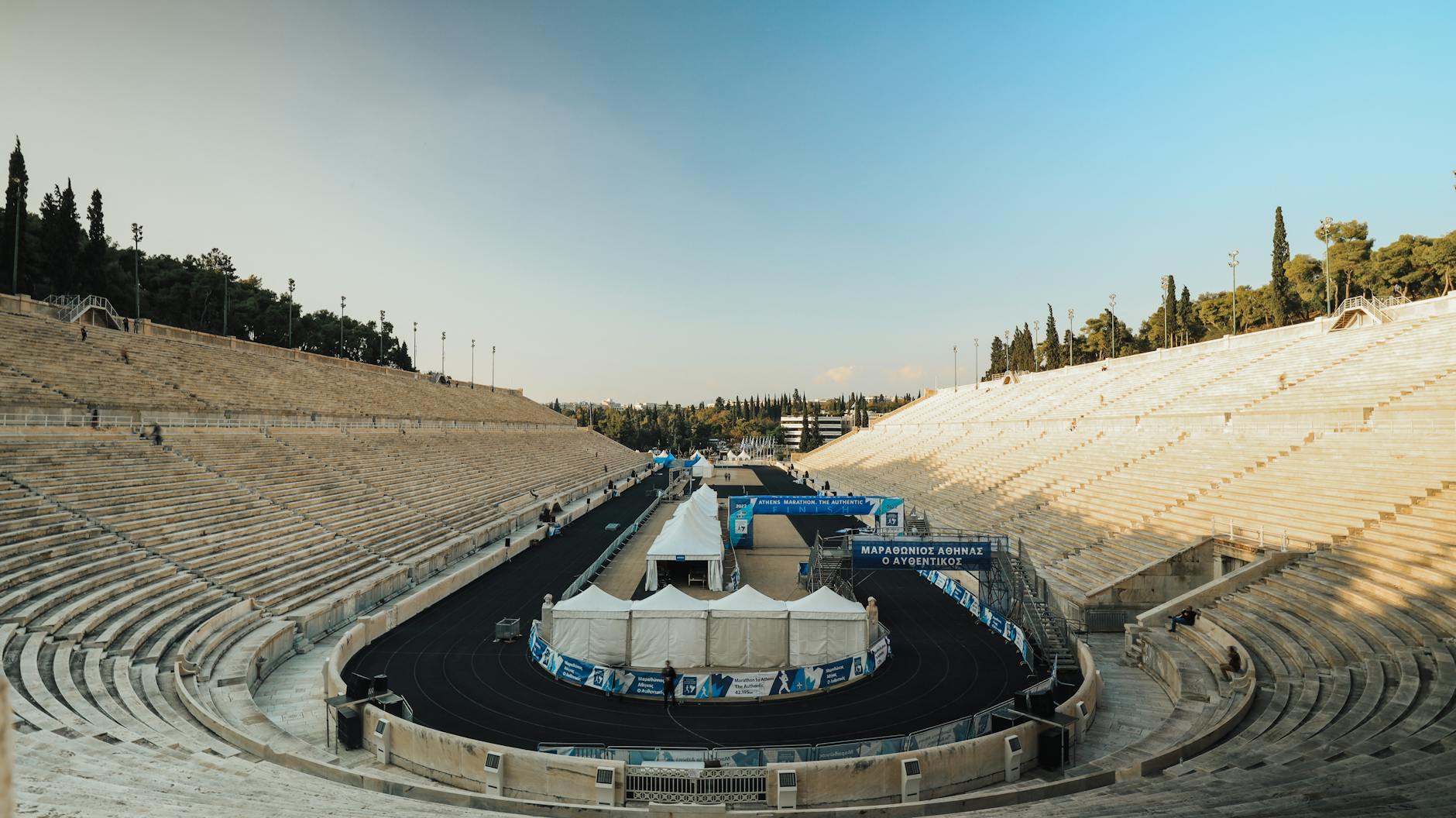
Greek public enthusiasm, once it caught fire, became the Games' salvation. A diaspora businessman named Georgios Averoff donated the equivalent of nearly $120,000 — an enormous sum — to restore the ancient Panathenaic Stadium in marble. Fundraising campaigns swept through Greek communities around the world. The stadium that Averoff rebuilt still stands in Athens today.
What Happened in Athens
The Games that opened on April 6, 1896 — the 75th anniversary of Greek independence — were, by any measure, a triumph. More than 60,000 spectators packed the Panathenaic Stadium for opening day. Athletes competed across 43 events in nine sports, including track and field, gymnastics, wrestling, weightlifting, cycling, swimming, shooting, tennis, and fencing.
American athletes, many of them representing the Boston Athletic Association and Princeton University, showed up largely on their own initiative and promptly dominated the track and field events. James Connolly became the first Olympic champion of the modern era, winning the triple jump on April 6. Sprinter Thomas Burke won both the 100 meters and 400 meters. The American team took nine of the twelve track and field gold medals — establishing a pattern of US dominance in Olympic athletics that would persist, with interruptions, for well over a century.
The marathon — a new event, created specifically for the 1896 Games to honor the legendary Greek messenger who ran from Marathon to Athens — was won by a Greek postal worker named Spyridon Louis, sending the crowd into delirium. It remains one of the most celebrated moments in Olympic history.
The Legacy of a Long Shot
Coubertin's creation outlasted him, outlasted the IOC he founded, and outlasted every government, empire, and ideology that has tried to bend it to political purposes. The modern Olympics have been canceled by world wars, boycotted by superpowers, and shadowed by tragedy. They've also produced some of the most transcendent athletic moments in human history.
For American sports fans, the Olympics have become a quadrennial ritual — a moment when track and field, gymnastics, swimming, and a dozen other sports that rarely get primetime coverage suddenly command the full attention of the country. That ritual exists because a stubborn French baron refused to take no for an answer in the 1880s.
The ancient Games at Olympia ran for over a thousand years. The modern Games, now in their second century, show no signs of stopping.
Not bad for a passion project everyone said would never work.