Death, Distance, and Democracy: How a Greek Soldier's Final Mission Created America's Most Punishing Race

The Run That Started a Revolution
Every October, when 50,000 runners toe the starting line at the New York City Marathon, they're chasing more than a finish time. They're following in the footsteps of Pheidippides, a Greek soldier whose legendary sprint from the battlefield at Marathon to Athens in 490 BC accidentally created America's favorite endurance challenge.
 Photo: New York City Marathon, via ceritalari.com
But here's the twist: Pheidippides probably never ran the distance we call a marathon today. The story we know—Greek messenger runs 26.2 miles, delivers victory news, dies dramatically—is likely a beautiful myth stitched together from multiple historical accounts centuries after the fact. Yet this questionable legend became the foundation for one of the world's most grueling sporting events.
From Battlefield to Boston
The ancient Greeks actually had plenty of real running events in their Olympic Games, but none of them came close to 26.2 miles. The longest race in ancient Olympia was the dolichos, roughly 3 miles of back-and-forth sprinting on a short track. The Greeks valued speed and power, not the kind of grinding endurance that defines modern marathoning.
So how did we get from there to here? The answer lies in the romantic nationalism of 19th-century Europe.
When French educator Pierre de Coubertin was planning the revival of the Olympic Games in 1896, he wanted something special for the host city of Athens. His friend Michel Bréal suggested a race from the town of Marathon to Athens, roughly following Pheidippides' supposed route. The distance? About 24.85 miles, depending on the exact course.
That first Olympic marathon in 1896 was pure theater. Greek postal worker Spyridon Louis won in front of his home crowd, becoming an instant national hero. But the race was still finding its identity—different Olympic marathons used different distances until 1921, when 26 miles and 385 yards became the official standard (thanks to the 1908 London Olympics, where the course was extended to start at Windsor Castle and finish in front of the royal box).
The American Marathon Boom
For decades, the marathon remained an Olympic curiosity, something only elite athletes attempted. Then something remarkable happened in America during the 1970s. The jogging boom, sparked by books like Jim Fixx's "The Complete Book of Running," transformed distance running from an elite pursuit into a mass participation sport.
The Boston Marathon, first run in 1897, became the gold standard—a race so challenging that simply qualifying became a badge of honor among American runners. What started as 15 men running from Ashland to Boston grew into a cultural phenomenon that inspired hundreds of similar events across the country.
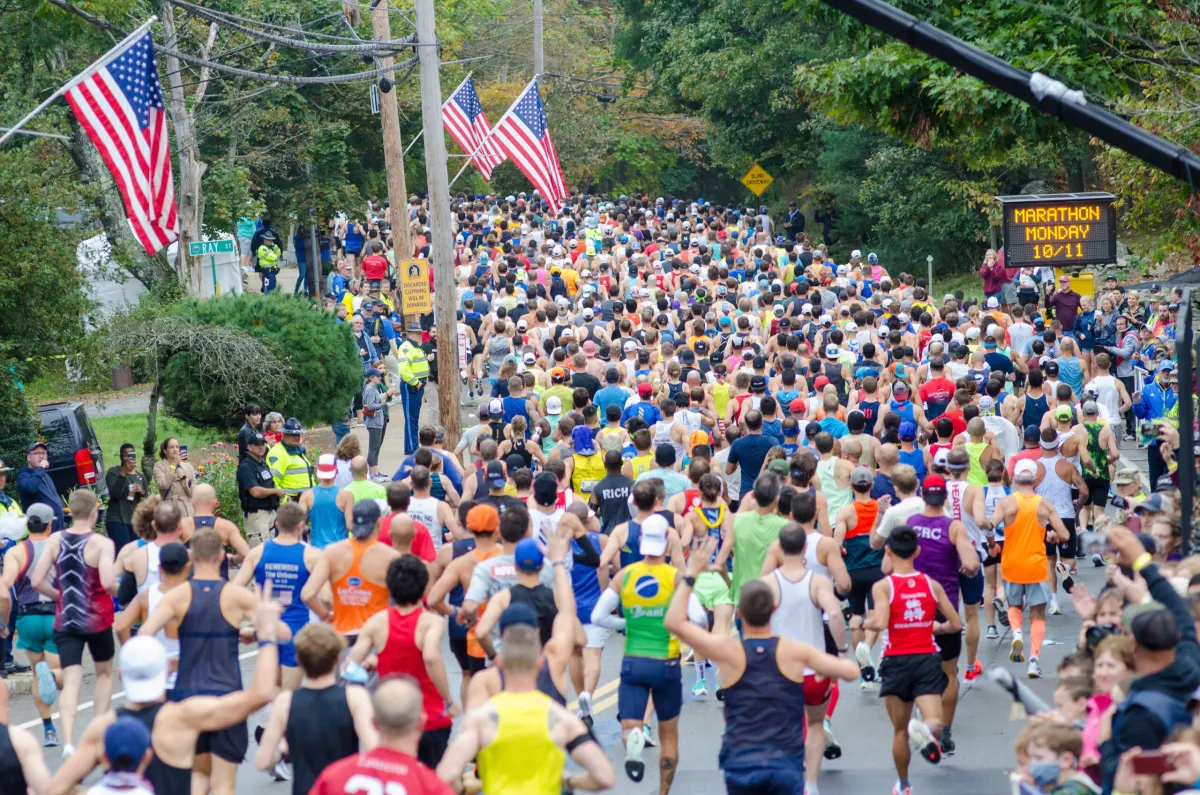 Photo: Boston Marathon, via marathontours.com
Today, over half a million Americans finish marathons every year. The distance that allegedly killed Pheidippides has become a bucket-list item for weekend warriors from Seattle to Miami.
Why 26.2 Miles Captures America's Imagination
There's something uniquely American about the marathon's appeal. It's not about natural talent or genetic gifts—it's about ordinary people choosing to do something extraordinary through sheer determination and months of grinding preparation.
The marathon embodies the American dream in athletic form: the belief that with enough hard work and persistence, anyone can achieve something remarkable. You don't need to be fast. You don't need perfect form. You just need to keep moving forward for 26.2 miles.
Consider the numbers: the average marathon finishing time in America is around 4 hours and 30 minutes. That's barely faster than a brisk walk for most of the distance. But crossing that finish line carries the same emotional weight whether you're an elite athlete or a back-of-the-pack plodder.
From Ancient Myth to Modern Reality
The irony is perfect: a race based on a story that probably never happened has become one of the most authentic tests of human endurance. Pheidippides may not have run from Marathon to Athens, but millions of modern athletes have proven that mere mortals can cover that distance and live to tell about it.
The ancient Greeks celebrated short bursts of speed and power—the sprint, the discus throw, the wrestling match. They probably would have thought our marathon obsession was slightly insane. Why voluntarily suffer for hours when you could demonstrate excellence in minutes?
But that's exactly what makes the marathon so compelling to modern Americans. In a world of instant gratification and quick fixes, the marathon demands patience, planning, and the willingness to embrace discomfort in pursuit of a distant goal.
The Legacy Lives On
Every weekend across America, thousands of runners gather at starting lines, ready to chase a distance that began as a military dispatch and evolved into a personal pilgrimage. They're not running for olive wreaths or ancient glory—they're running for something more personal and perhaps more meaningful: the simple satisfaction of proving to themselves that they can do something that seemed impossible.
Pheidippides, whether he existed or not, gave us more than a race distance. He gave us a metaphor for persistence, for pushing beyond what seems possible, for the idea that sometimes the most important finish lines are the ones we choose for ourselves. In a country built on the belief that ordinary people can do extraordinary things, the marathon remains the perfect athletic expression of that enduring faith.