From Bare Feet on Packed Earth to 9.58 Seconds: The Incredible Journey of the Olympic Sprint
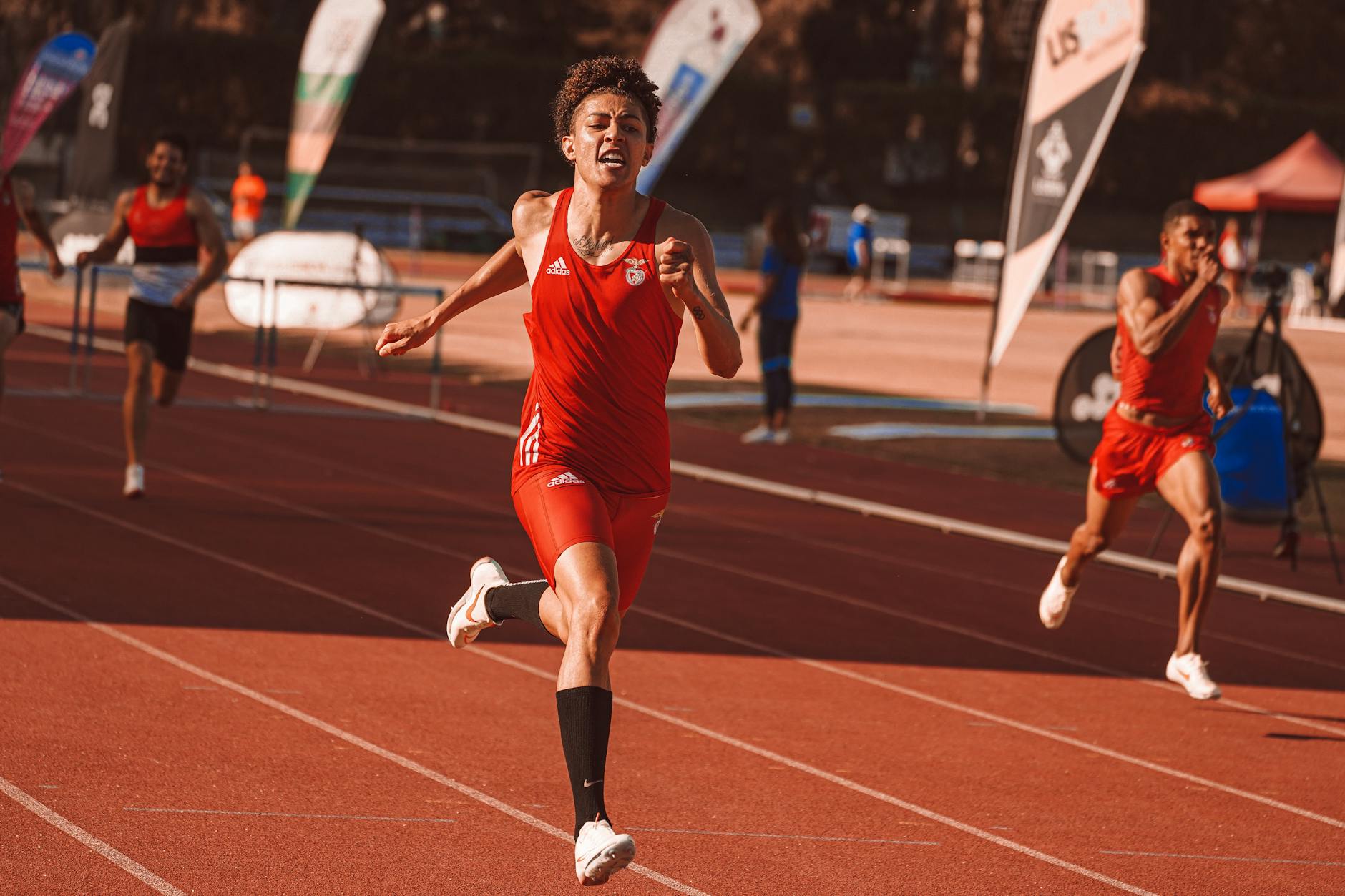
Somewhere around 776 BC, a cook named Coroebus sprinted roughly 200 meters down a packed-earth track at Olympia, Greece, and crossed the finish line first. He became the first recorded Olympic champion in history. No starting blocks. No synthetic surface. No spikes. Just bare feet, raw speed, and a crowd of Greeks who thought they were watching something divine.
Fast forward to Berlin, August 16, 2009. Usain Bolt exploded out of the blocks, hit full stride somewhere around the 60-meter mark, and crossed the finish line in 9.58 seconds — a world record that still stands today. The crowd wasn't watching something divine. They were watching something that, to ancient eyes, would have looked exactly like it.
Between Coroebus and Bolt lies one of the most fascinating stories in all of sports history. This is that story.
The Stadion: The Race That Started Everything
The ancient Greeks called it the stadion — a single-length sprint down the track at Olympia, believed to be roughly 192 meters long. It was the only event at the very first Olympic Games, and it remained the most prestigious race throughout the ancient era. Winning the stadion wasn't just an athletic achievement. It was a religious one. The Games were held in honor of Zeus, and the champion was seen as touched by the gods.
Runners competed barefoot on a surface of packed sand and earth. They started from a standing position, feet pressed against a stone balbis — a grooved starting sill carved into the ground. There were no lanes, no staggered starts, and no photo finishes. The winner was simply the first man to reach the other end.
Training existed, but it looked nothing like what modern athletes do. Greek competitors worked with personal trainers called paidotribes, who emphasized wrestling, running, and general physical conditioning. Diet was taken seriously — athletes were known to eat large quantities of meat, particularly pork and beef, which was unusual in a culture where most people ate grain and vegetables. But there were no heart rate monitors, no lactate threshold tests, and certainly no biomechanical analysis.
By modern standards, ancient sprinters were running on instinct.
The Long Gap: From Ancient Olympia to Athens 1896
The ancient Games were abolished in 393 AD by the Roman Emperor Theodosius I, who banned pagan festivals across the empire. Competitive sprinting didn't disappear entirely — foot races appeared throughout medieval Europe and colonial America — but the organized, international version of the sport went dark for nearly 1,500 years.
When the modern Olympics were revived in Athens in 1896, the sprint came back with them. Thomas Burke of the United States won the inaugural 100-meter dash in 12.0 seconds. That's not a typo. Twelve seconds. Burke was considered a phenomenon at the time, and by the standards of 1896, he absolutely was.
But here's the thing: Burke's technique was already a preview of the future. He crouched low at the start — a position that looked bizarre to European competitors used to upright standing starts — and drove out aggressively. He had, essentially, invented what would eventually become the standard sprint start.
The Technology That Changed Everything
The gap between Thomas Burke's 12.0 and Usain Bolt's 9.58 didn't close overnight. It closed in layers, each generation of sprinters benefiting from a new wave of innovation.
Starting blocks arrived in the 1920s and became standard at the 1948 London Olympics. Before blocks, runners dug small holes in the track with trowels to brace their feet. Blocks gave athletes a consistent, explosive launch platform, shaving fractions of a second off reaction time and initial acceleration.
Track surfaces underwent a revolution in the 1960s and 70s. The cinder and clay tracks that Burke ran on — and that Jesse Owens ran on when he won four gold medals in Berlin in 1936 — were replaced by polyurethane synthetic surfaces. Modern tracks are engineered to return energy to the runner with every footfall, essentially giving back a small percentage of the force that goes into the ground.
Sprint spikes evolved from basic leather shoes with crude metal studs into precisely engineered racing tools. Today's sprint spikes are built around carbon fiber plates, weigh almost nothing, and are designed in collaboration with biomechanics researchers to optimize the angle of force application through each stride.
Sports science may be the biggest factor of all. Modern sprinters train with GPS-based velocity tracking, high-speed video analysis, and individualized strength and conditioning programs built around their specific biomechanical profiles. They know their stride frequency, their ground contact time, their acceleration curve. They train smarter, recover faster, and peak more precisely than any previous generation.
And then there's the global talent pool. The ancient Olympics drew competitors almost exclusively from Greek city-states. The modern Games pull from nearly 200 nations. The more people competing, the more likely you are to find someone with the rare genetic combination — fast-twitch muscle fiber distribution, limb proportions, neurological response time — that produces a once-in-a-generation sprinter.
What Bolt's Record Actually Means
Usain Bolt's 9.58 seconds in Berlin works out to a top speed of roughly 27.8 miles per hour. To put that in context, the average human runs about 8 mph. A fit recreational runner might hit 12 mph at full sprint. Bolt was running more than twice as fast as that — and sustaining it.
Bolt is also 6-foot-5, which was long considered too tall for elite sprinting. Conventional wisdom said taller athletes couldn't accelerate quickly enough out of the blocks to compete with shorter, more explosive runners. Bolt rewrote that assumption entirely, combining elite acceleration with a stride length that shorter competitors simply couldn't match at top speed.
Coroebus, standing at the starting line in Olympia 2,800 years ago, could not have imagined any of this. The track, the blocks, the shoes, the science — none of it existed. But the race? The race was the same. Get to the other end first.
That's the thing about the sprint. Everything around it has changed. The essence of it never has.
Why This History Still Matters
Every time a sprinter settles into the blocks at a major meet, they're participating in the oldest competitive athletic tradition in the Western world. The stadion at Olympia is the direct ancestor of the 100-meter dash at the Olympics. The first champion was a Greek cook. The current world record holder is a Jamaican who ran faster than any human being in recorded history.
The distance between those two facts is the entire story of human athletic progress — and it's still being written.