When Winning Was in the Eye of the Beholder: How Ancient Greeks Declared Champions Without a Clock
The Moment Everything Changed
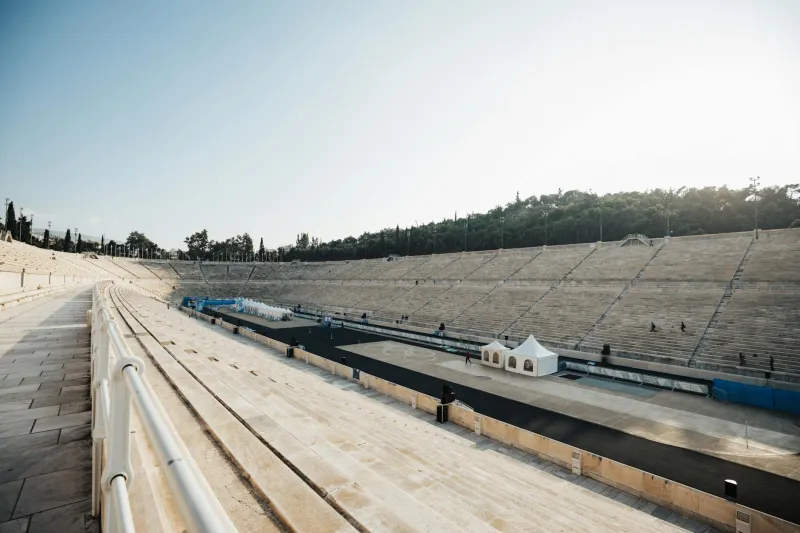
Picture this: It's 776 BC in Olympia, Greece. Two runners are sprinting toward the finish line of the stadion race, separated by mere inches. The crowd of thousands is roaring. There's no photo finish camera, no electronic timing system, no instant replay. Just a group of judges squinting in the Mediterranean sun, trying to figure out who crossed the line first.
This was the reality of athletic competition for over 2,500 years. Long before we had the luxury of measuring victories in thousandths of a second, ancient Greeks had to solve a fundamental problem that still haunts modern sports: How do you fairly determine a winner when the margin of victory is smaller than the human eye can detect?
The Art of Ancient Judging
The Greeks took this challenge seriously. They developed a sophisticated system of officials called Hellanodikai — literally "judges of the Greeks" — who were responsible for maintaining order and declaring winners. These weren't casual volunteers picked from the crowd. They underwent months of training and were considered among the most important figures at the Games.
The judging process was surprisingly complex. For the stadion race, multiple judges would position themselves at different points along the finish line. When runners approached, each judge would focus on a specific section of the line, then confer with their colleagues to reach a consensus. Think of it as an ancient version of today's photo finish review, except instead of examining a high-speed image, they were comparing human memories and perspectives.
But here's where it gets interesting: the Greeks didn't just wing it. They developed physical markers and reference points to help judges make accurate calls. The finish line wasn't just a rope stretched across the track — it was often a precisely carved stone threshold or a series of wooden posts that created clear visual boundaries.
When Eyes Failed and Chaos Followed
Of course, this system wasn't foolproof. Ancient sources record numerous disputes over close finishes, some of which led to riots among spectators who disagreed with the judges' decisions. The most famous controversy occurred during the 67 AD Olympics when Emperor Nero supposedly "won" a chariot race despite falling out of his chariot and never finishing the race. While this was clearly corruption rather than a judging error, it highlights how subjective ancient athletic decisions could be.
More legitimate disputes arose in genuinely close races. When judges couldn't agree on a winner, they sometimes declared ties — a concept that seems foreign to modern Olympic competition but was an accepted solution in ancient Greece. In some cases, they would order re-races, though this was rare and usually reserved for shorter events where fatigue wouldn't dramatically affect the outcome.
The Birth of Precision
The Greeks' struggles with accurate timing and judging planted the seeds for our modern obsession with precision in sports. By the time Baron Pierre de Coubertin revived the Olympics in 1896, mechanical stopwatches had been invented, but they were still operated by human hands and prone to error.
The real revolution came in the 20th century. The 1912 Olympics in Stockholm featured the first semi-automatic timing system, though judges still made the final decisions. It wasn't until the 1972 Olympics in Munich that electronic timing became the official standard, eliminating human error from the equation.
Today's timing systems are so precise they can measure differences of 0.001 seconds — a level of accuracy that would seem like magic to those ancient Greek judges. When American sprinter Noah Lyles won the 100-meter gold medal at the 2023 World Championships by just 0.005 seconds, the margin of victory was literally invisible to the human eye.
What Ancient Judging Taught Us About Fairness
The Greek approach to judging reveals something profound about the nature of athletic competition. Despite their technological limitations, they understood that perceived fairness was just as important as actual fairness. The elaborate training process for judges, the multiple officials at each event, and the public nature of their decisions all served to build trust in the system.
This principle still guides modern sports administration. Yes, we have incredibly accurate timing systems, but we also have extensive protocols for equipment calibration, backup systems, and appeals processes. The instant replay systems used in American football, basketball, and baseball are essentially high-tech versions of the Greek practice of having multiple officials review close calls.
The Legacy Lives On
Every time you watch a photo finish at a horse race, see a swimming touch pad light up, or witness a marathon runner cross the line with an official time down to the second, you're seeing the evolution of a problem first tackled by those ancient Greek judges in Olympia.
The Greeks may not have had stopwatches, but they gave us something equally valuable: the understanding that athletic competition demands both precision and trust. Their imperfect system of human judgment evolved into today's technological marvels, but the core principle remains the same — every athlete deserves a fair chance to prove they're the fastest, strongest, or best.
In a world where Olympic records are broken by margins measured in thousandths of a second, it's worth remembering that it all started with a group of dedicated officials in ancient Greece, doing their best to call it like they saw it.