Statues, Free Meals, and Poets on Retainer: Ancient Greece Invented the Sports Celebrity
Usain Bolt has a statue at the Beijing National Stadium. Simone Biles has a Barbie doll, a skill named after her on the uneven bars, and a level of cultural visibility that transcends sport entirely. Patrick Mahomes has a shoe deal, an endorsement portfolio, and more social media followers than most countries have citizens.
We treat this kind of athletic celebrity as a product of the modern media age — something that required television, the internet, and the entire machinery of professional sports marketing to create.
We're wrong. The sports star is an ancient invention. And the civilization that built it understood its power with remarkable clarity.
What Winning at Olympia Actually Got You
The prize awarded to victors at the ancient Olympic Games was, on its face, absurdly modest: a wreath of olive branches cut from a sacred tree near the Temple of Zeus. No cash. No gold medal. Just leaves.
But that wreath was a key that unlocked something enormous.
Olympic champions returned home to receptions that look, in historical description, almost indistinguishable from a modern championship parade. Cities tore down sections of their walls to welcome victorious athletes — the symbolic logic being that a city with a champion among its citizens had no need of defensive fortifications. The champion was the protection.
From there, the rewards cascaded. Free meals for life, provided at public expense, was a standard honor in many Greek city-states. Athens offered cash payments to Olympic victors — the equivalent, by some estimates, of several years' wages for an ordinary worker. Front-row seats at public events, exemption from certain civic duties, and a kind of permanent social elevation came with the wreath.
And then there were the statues.
The Original Endorsement Deal: Having Your Face Everywhere
A victorious Olympian of sufficient fame could expect a statue erected in their honor at Olympia itself — the most prestigious public space in the Greek world, visited by tens of thousands of pilgrims during every Games. For particularly dominant champions, statues appeared in their home cities as well, in the agora or at temples, places where ordinary people moved through daily life.
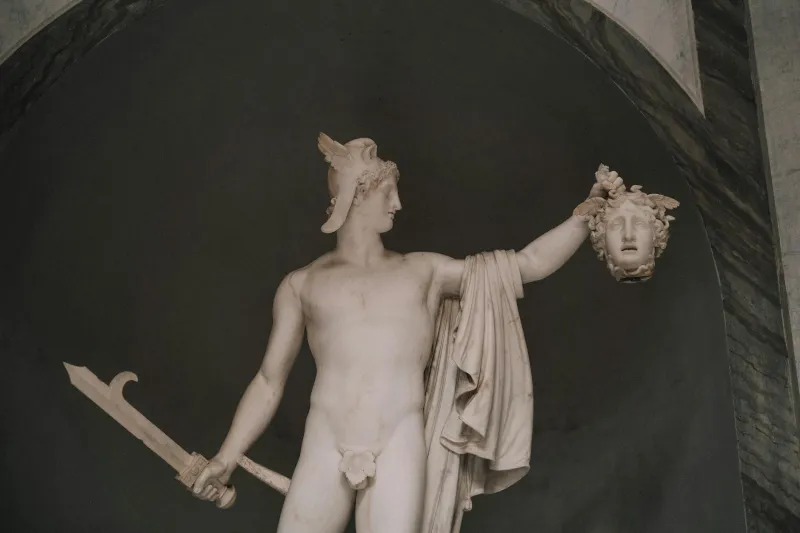
Think about what that meant in a world without photography, without video, without any form of mass media. A statue was the only way to make a face universally recognizable. Having one placed in a public square was the ancient equivalent of being on a billboard in Times Square — except the billboard never came down.
Some champions accumulated multiple statues across multiple cities. Theagenes of Thasos, a legendary boxer and pankratiast who competed in the fifth century BC, reportedly had over 1,400 statues erected in his honor across the Greek world during and after his lifetime. Whether that number is precise or apocryphal, the point stands: elite ancient athletes achieved a kind of omnipresence in the visual culture of their time that was reserved for gods and rulers.
Pindar and the Poets: Ancient Sports Media
No discussion of ancient athletic celebrity is complete without Pindar, the Theban poet who made his career — and a very comfortable living — writing victory odes for Olympic and other Panhellenic champions.
Pindar's Epinician Odes are among the most celebrated works of ancient Greek literature. They are also, at their core, commissioned sports content. Wealthy victors or their families paid Pindar to craft elaborate poems celebrating their achievements, linking their victories to divine ancestry, mythological heroes, and the glory of their home cities.
This is not fundamentally different from a modern athlete hiring a documentary crew, a ghostwriter for their memoir, or a PR firm to manage their public narrative. The technology is different. The function is identical: control the story, amplify the achievement, cement the legacy.
Pindar understood something that modern sports media has always known — athletic achievement is raw material. What turns it into lasting cultural power is storytelling.
Leonidas of Rhodes: The First Household Name
If ancient Greece had a GOAT debate, Leonidas of Rhodes would be near the center of it.
Competing across four consecutive Olympic Games from 164 BC to 152 BC, Leonidas won twelve individual crowns across three running events — the stadion (roughly 200 meters), the diaulos (roughly 400 meters), and the hoplitodromos (an armored race). He was the fastest man of his era across multiple distances, dominant for over a decade at the highest level of ancient competition.
His fame extended far beyond Rhodes. His name was known across the Greek world. He was referenced by later writers as a standard of excellence — the kind of athlete whose achievements became a benchmark for measuring everyone who came after.
Sound familiar? That's the Usain Bolt model. Exceptional performance at the peak event of the Games, sustained dominance across multiple Olympics, a name that becomes synonymous with a standard of excellence. Leonidas didn't have Instagram, but he had something that functioned identically: a reputation that traveled the ancient world through word of mouth, written accounts, and those statues placed in prominent public spaces.
Why This Matters for American Sports Culture
America's relationship with sports celebrity is intense, commercially sophisticated, and sometimes genuinely bizarre. We name stadiums after athletes, build entire media ecosystems around individual stars, and treat championship victories as civic events.
None of that is new. Every element of it — the public honors, the economic rewards, the media amplification, the way athletic achievement becomes a vehicle for broader cultural meaning — was operating in ancient Greece with remarkable sophistication.
The ancient Olympics weren't just a sporting competition. They were a cultural institution that understood athletic excellence as a form of social capital, a way of projecting the power and prestige of individuals, families, and city-states. The athletes who competed weren't just trying to win. They were building legacies.
From Olympia to the Super Bowl, that ambition has never changed. Only the platforms have.